 Otto
OttoCapture, Queue, Act: AI That Stops Missed Follow Ups for Busy Leaders
Capture, Queue, Act: AI That Stops Missed Follow Ups for Busy Leaders

The fix is simple to describe and harder to run without a system: capture every commitment the moment it happens, make setting a reminder nearly effortless, and let short automated sequences carry the follow-up with a human sign-off before anything sends. Do those three things and missed follow-ups stop being a weekly problem. A realistic success signal is a clean week: zero overdue follow-ups for seven straight days.
TL;DR:
- Setting reminders should be frictionless, with a single, low-effort method and automation to ensure follow-ups are never missed.
- Capturing promises immediately and phrasing them as commands helps prevent vague notes and makes follow-up actionable.
- A structured follow-up cadence involves a next-day message, a few days later, and a final attempt within a week to ten days, adjusted for urgency.
- An effective system automates the capture, scheduling, and drafting of follow-ups, with human approval before anything is sent to maintain tone and judgment.
- Consistent habits like daily triage, batching follow-up writing, and simplifying decision points are crucial for sustaining reliable follow-up routines.
Table of Contents
- 10-minute checklist: fixes you can make now
- Designing a reliable follow-up system: capture → queue → act
- Small habits that keep your system working
- Copy-ready follow-up templates and scheduling scripts
- When to follow up, when to escalate, and when to stop
- How an integrated AI chief of staff operationalizes this
- Common mistakes and realistic outcomes
- A practical option for staying on top of follow-ups
- Sources
- FAQ
10-minute checklist: fixes you can make now
Most missed follow-ups trace back to a handful of fixable habits, not a lack of discipline. Before building anything elaborate, run through this list and fix what you can in the next ten minutes.
- Capture every open promise right now: write it as one sentence with an owner and a due date, not a vague note to “circle back.”
- Pick one low-effort reminder method and drop the others: a calendar invite or a single-click task app beats a sticky note or a mental tally.
- Turn on a two-step follow-up sequence for any external lead who hasn’t replied, so the second nudge goes out without you remembering to write it.
- Save three short templates (first message, nudge, final attempt) so you’re never starting from a blank screen under time pressure.
- Watch one number daily: your count of overdue follow-ups, and nothing else, until it hits zero.
None of this requires new software if you don’t want it yet. A shared calendar and a task list can carry you through the first month. What matters is consistency: the same capture habit and the same reminder method every time, because research on reminder-setting shows that even small increases in the effort required to set a reminder measurably reduce how often people bother to set one at all. Friction is the enemy, not motivation.
Designing a reliable follow-up system: capture → queue → act
A follow-up system has three jobs: catch the commitment, hold it somewhere reliable, and prompt action at the right time. Skipping any one of the three is why most people leak follow-ups even when they’re trying hard.
- Capture at the source. Meeting notes, call summaries, and inbound emails should feed a single queue the moment a promise is made, not after you’ve had time to forget the details.
- Use low-effort capture patterns. Email-to-task shortcuts, calendar quick-add, and meeting transcription that converts spoken commitments into tasks all remove the friction that kills good intentions.
- Automate the trigger. When a new promise lands in the queue, the system should schedule a reminder and draft the follow-up message automatically, with a human still approving before anything sends.
- Prioritize integrations that touch your actual workflow. Calendar, email, meeting notes, and your CRM matter more than any single flashy feature, because each one is a place where a commitment can currently slip through.
The cost of getting this wrong shows up fast. Harvard Business Review documented that many online sales leads go unanswered or get contacted too slowly, and slow follow-up is a direct cause of lost business. Speed and consistency in the queue, not cleverness in any one message, is what protects revenue and relationships alike.
Small habits that keep your system working
Tools fail quietly when the habits around them are weak. Four small routines keep a follow-up system running even on your busiest weeks.
First, capture promises the instant they’re made, phrased as an action: “Send Marta the pricing sheet by Friday” instead of “follow up with Marta.” Second, run a five-minute daily triage, ideally first thing, to clear anything overdue and re-rank what’s coming due today. Third, batch your actual follow-up writing into one protected 20 to 30 minute block rather than answering pings all day, since context-switching is where messages get skipped. Fourth, cut decisions wherever you can: one template per situation, one reminder method, one place things live.

That last point matters more than it sounds. Research on intention-offloading found that people set more reminders when the process is simple and when they have less confidence they’ll remember on their own, which means a frictionless system doesn’t just help the disorganized: it helps everyone offload more reliably.
Pro Tip: Write every captured commitment as a command aimed at your future self, not a description of the situation. It’s the difference between a task you can act on immediately and one you have to re-read twice to understand.
Copy-ready follow-up templates and scheduling scripts
Writing the message is often the actual bottleneck, not deciding whether to send one. These short templates remove that barrier.
- First follow-up: “Following up on [item], want to make sure it didn’t get buried. Can you take a look by [date]?”
- Value-add nudge: “Circling back with [resource attached] in case it helps. Still aiming for [deadline]?”
- Final attempt: “Haven’t heard back, so I’ll leave this here. Reach out anytime if the timing shifts.”
For scheduling, a one-line message with a booking link (“Grab a time that works here: [link]”) beats a back-and-forth every time.
- Keep internal follow-ups direct and short, since your colleagues already have context.
- Warm external follow-ups slightly with one specific detail from your last conversation, but keep it to two sentences.
When to follow up, when to escalate, and when to stop
Guessing at timing is how good systems fall apart. A standard cadence works for most situations: a first follow-up the next day, a nudge a few days later, and a final attempt within about a week to ten days, accelerated for anything time-sensitive or high-value.
- Classify by urgency and stakes: high priority gets same-day follow-up, medium gets the standard cadence, low priority can wait for a weekly batch.
- Escalate when a final attempt gets silence, when a hard deadline is missed, or when the task is tied to something mission-critical.
- Stop and archive once you’ve hit your attempt cap, a set time limit, or the other person has explicitly opted out.
- Track two numbers weekly: overdue follow-ups outstanding and your response rate within the first 24 hours.
These rules matter because response speed still drives outcomes: HBR’s lead research found that delayed contact is a direct cause of lost opportunities, so a defined cadence protects you from your own inbox anxiety as much as from actual neglect.
How an integrated AI chief of staff operationalizes this
Otto is built around a single shared memory that holds email, calendar, meetings, and commitments in one place, so nothing has to be re-explained between tools. That structure maps directly onto the capture-queue-act system described above.
- A promise made out loud in a meeting becomes a task automatically, with no manual note-taking required.
- A commitment buried in an email thread gets queued for follow-up instead of sitting unread.
- Every drafted message waits for explicit approval before anything sends, which keeps a human in the loop on tone and judgment.
This kind of setup fits founders, chiefs of staff, and operators whose commitments are scattered across a dozen tools and who are effectively acting as the integration layer themselves, copying context by hand all day.
Common mistakes and realistic outcomes

The three failure modes I see most: promises never captured in the first place, tasks written too vaguely to act on later, and reminder systems with enough friction that people quietly stop using them. Automation helps with all three, but Gartner’s research found that 69% of B2B buyers still turn to a human to validate AI-generated insights, which is a reminder that automation drafts but doesn’t replace judgment.
Expect fewer dropped threads within 30 days, a visibly shorter overdue list by 90, and a genuinely calmer inbox by 180, assuming the habits underneath the tool hold.
— Eddie
A practical option for staying on top of follow-ups
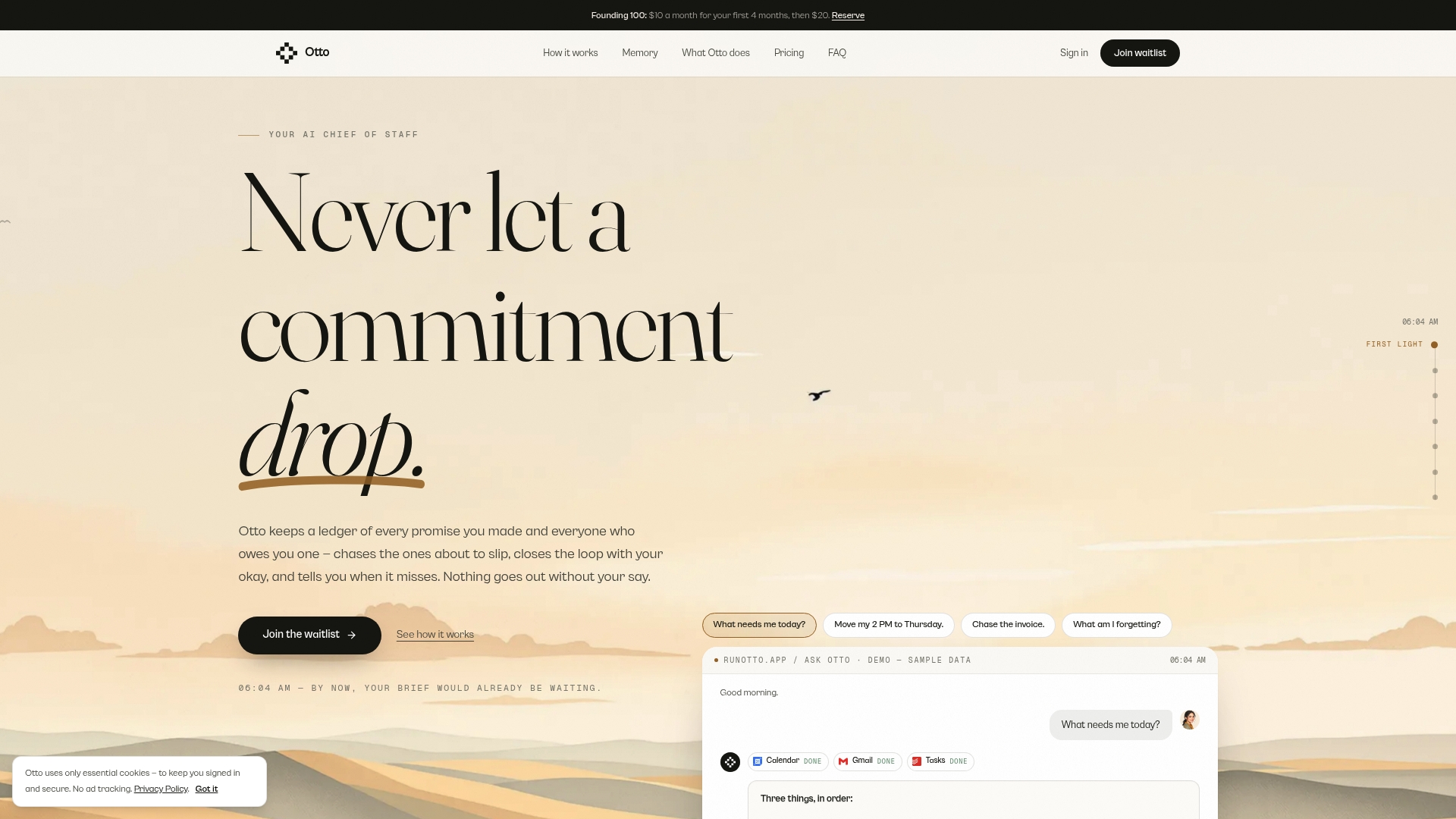
Everything in this article, capturing at the source, keeping reminders low-effort, and automating short sequences with a human sign-off, is what Otto is built to do. It listens in meetings, reads your email and calendar, and turns every promise it finds into a single ledger it keeps chasing until the item closes, drafting the follow-up but never sending it without your approval.
If your follow-ups currently live across a notebook, three apps, and your memory, that’s the exact gap Otto is meant to close. You can start on the Free plan and see how it handles a real week of commitments before deciding whether Upgraded or Max fits your workload.
Sources
- Gartner survey: 69% of B2B buyers turn to sales reps to validate AI-generated insights
- EXPRESS: Influence of the physical effort of reminder-setting on strategic offloading of delayed intentions
- The short life of online sales leads — Harvard Business Review
FAQ
What’s the fastest way to stop missing follow-ups?
Capture every commitment the moment it’s made, use one low-effort reminder method instead of several, and let a short automated sequence handle the nudges. This removes the two biggest causes of dropped follow-ups: forgetting to record the promise and the effort of setting reminders manually.
How often should I follow up before giving up?
A common cadence is 24 hours for the first follow-up, 3 days for a nudge, and about a week to ten days for a final attempt before you stop. High-stakes or time-sensitive items should move faster, while low-priority ones can wait for a weekly batch.
Why do low-effort reminders work better than complex systems?
Increasing the physical effort needed to set a reminder reduces how often people actually set one, even when they intend to. A one-click reminder gets used consistently, while a multi-step process quietly gets skipped under time pressure.
Should follow-up messages be fully automated?
Automated drafting saves time, but human review still matters: Gartner found that 69% of B2B buyers still turn to a person to validate AI-generated output. A draft-and-approve step helps keep tone and judgment intact while still reducing the manual work of writing each message.
Does Otto send follow-up messages automatically?
No. Otto drafts follow-ups based on commitments it captures from your email, calendar, and meetings, but nothing sends without your explicit approval. That keeps you in control of tone and timing while removing the manual work of remembering and writing each one.